

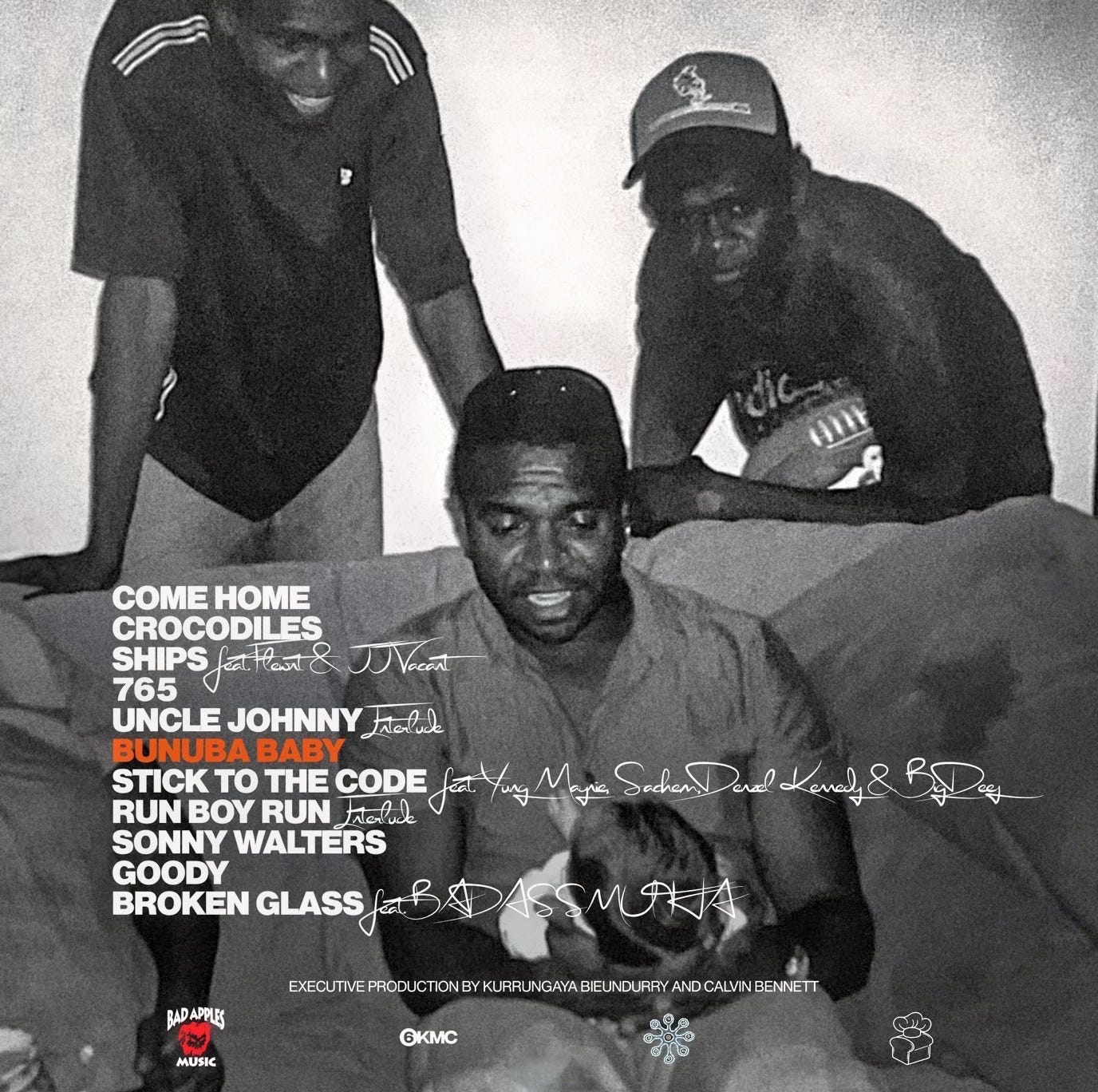
There is a moment on BUNUBA BABY where Kayps remembers seeing photographs of his Elders hanging when he was a child. He didn’t fully understand what he was looking at, so the question that entered his head was an innocent one: “Why is Uncle levitatin’?”
It is only one line on an album filled with difficult ones, but it says a lot about how far Kurrungaya Bieundurry has come as a songwriter.
Kayps has been making music since he was around 13, and for anyone who has followed his work, his ability has never really been in question. He can move between melodic hooks and rapid-fire flows with ridiculous ease, jump between genres without losing himself and, when he wants to, simply outrap the people around him. At 20, he already has the kind of technical confidence that usually comes much later.
What has changed on this album is what he is doing with it.
Released on 14 August, BUNUBA BABY feels like the first time everything around Kayps has been brought into the same place. His childhood, his Bunuba and Walmatjarri identity, Fitzroy Crossing, family, racism, colonisation, stolen wages, people he has lost, his years away from home and his own uncertainty about what that distance has done to him all become part of the record.
It would have been easy for an album carrying this much history to become overwhelmingly heavy, but Kayps understands that the place he is writing about cannot be represented through trauma alone. There is too much love there for that.
The first voice we hear isn’t even his.
Natalie Davey opens “Come Home” through Wangki Radio, welcoming listeners from across the Fitzroy Valley before introducing BUNUBA BABY. It gives the album an immediate sense of place, almost as though what we’re about to hear is being broadcast across the community it belongs to.
Kayps follows by giving us the kind of details that rarely appear when people talk about regional communities from the outside. Four-wheel drives, the heat, cigarette smoke outside a clinic, a drum kit in the meeting building, cousins fighting on the grass, the IGA, trying to heat up a feed when there’s no microwave around. There is nothing particularly grand about these images, which is precisely why they work.
The darker realities exist right beside them too. A booze ban, rehab and a cousin who died at 25 after Kayps had told him he’d see him soon.
“Sugar coating where I’m from could never make me hide away,” he says towards the end of the verse.
That refusal to simplify home becomes one of the most important ideas running through the album.
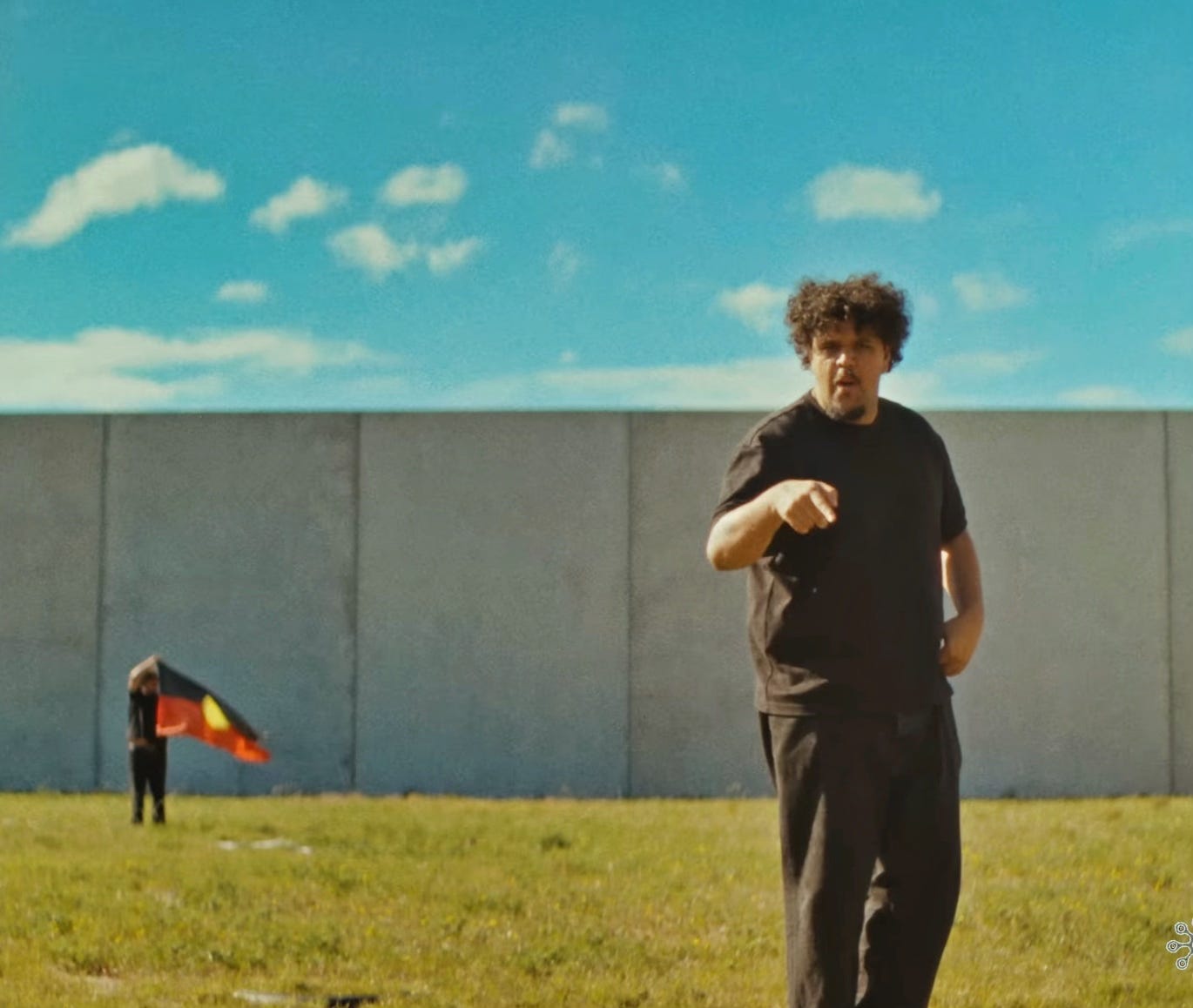
“CROCODILES” carries the same feeling forward, but with more warmth. Kayps writes about returning northwest, fishing after the rain, the riverbank, red dirt, dry season and crocodiles sitting in the water. Yet within the same song, he is writing about songlines being washed away by the West, stolen wages and generations of people fighting to hold onto culture.
Neither side cancels out the other.
The Fitzroy Valley Kayps gives us is beautiful because it is home, and painful because of what has happened there. The anger that naturally comes from that becomes much harder to ignore on “SHIPS”.
Kayps goes back to being the only Black kid in his class, remembering the prejudice that surrounded him and eventually being told that he was “too black”. His response isn’t restrained, nor should it be. The track carries an aggression that feels built from years of being expected to absorb those experiences quietly.
Flewnt and JJ Vacant extend that feeling beyond Kayps himself. Flewnt’s verse in particular is brilliant, moving from cultural pride towards stolen wages and the demand for greater space, funding and recognition. By the time the song ends, it no longer feels like one person’s frustration. The voices around Kayps are becoming an increasingly important part of the album.
That sense of community is something the album returns to constantly. Kayps may be at the centre of the record, but he rarely writes as though his story exists by itself.
On “765”, one of the strongest performances on the album, he moves between his own experience and something much older almost without warning. The track is technically impressive — Kayps’ delivery alone could give plenty of rappers a run for their money — but what makes it work is that none of that technical ability gets in the way of what he’s actually saying.
He talks about his culture being criminalised, wanting land returned and still waiting on his grandfather’s stolen wages before reaching one of the most haunting images on the entire album:
“As a youngin, I saw photos of my Elders hangin’
Lil’ me thinkin’, ‘Why is Uncle levitatin’?’”
There is something devastating about seeing that through the eyes of a child who doesn’t yet understand what he’s looking at. Kayps is smart enough not to explain the moment any further. He leaves the image there and keeps moving.
But for everything “765” carries, this doesn’t sound like a song weighed down by its subject matter. It’s huge. The hook sticks almost immediately, Kayps attacks the beat and there is a confrontational energy to the whole thing that makes me wonder what this song could become once people have had some time with it.
There is something about “765” that reminds me of what happened with Kendrick Lamar’s “Not Like Us”. Not necessarily in how the two songs sound, but in their ability to carry something much heavier inside music that people can gather around. Kendrick made a diss track that thousands of people ended up shouting together, and listening to “765”, you can imagine Kayps getting his own version of that moment.
“765 section steppin’, tell me where you from.”
Give that line a crowd and you can already hear what happens next.
And if it does become that kind of song for him, there is something pretty powerful about what people will actually be shouting along to. A track about being a Black boy from the northwest, about culture being criminalised, stolen wages, land, family and the things he saw growing up has been packed inside one of the most immediate songs on the album.
Kayps hasn’t watered any of it down to make an anthem. The things he wants to say are the anthem.
That makes the “UNCLE JOHNNY” interlude that follows feel particularly important.
An older voice recalls trucks approaching while people sat in the middle of the river. They were told to move. Some did, while others locked arms and stayed before being taken away one by one.
“It was like a war to me,” he remembers. “I was really scared.”
There is no verse from Kayps afterwards trying to contextualise what we’ve heard. The memory is allowed to exist on its own, and after hearing “765” immediately before it, the relationship between the two generations becomes difficult to miss. One carries the memory of what happened; the other is figuring out what to do with everything that memory has left behind.
There is a quote commonly attributed to Jimi Hendrix that I’ve carried around in my wallet for years: “When the power of love overcomes the love of power, the world will know peace.”
I found myself thinking about it a lot while listening to the album, because so much of the history sitting underneath this album eventually leads you back to power. Who had it, who didn’t, what people were willing to do to keep it, and what happens when the consequences of those decisions are inherited by generations who had nothing to do with making them.
History isn’t sitting somewhere safely in the past on this record. Kayps is talking about his grandfather’s wages. He’s talking about photographs he saw as a child. He’s talking about things his family and community are dealing with now. The distance between what Uncle Johnny remembers and what this 20-year-old is rapping about isn’t nearly as large as it should be.
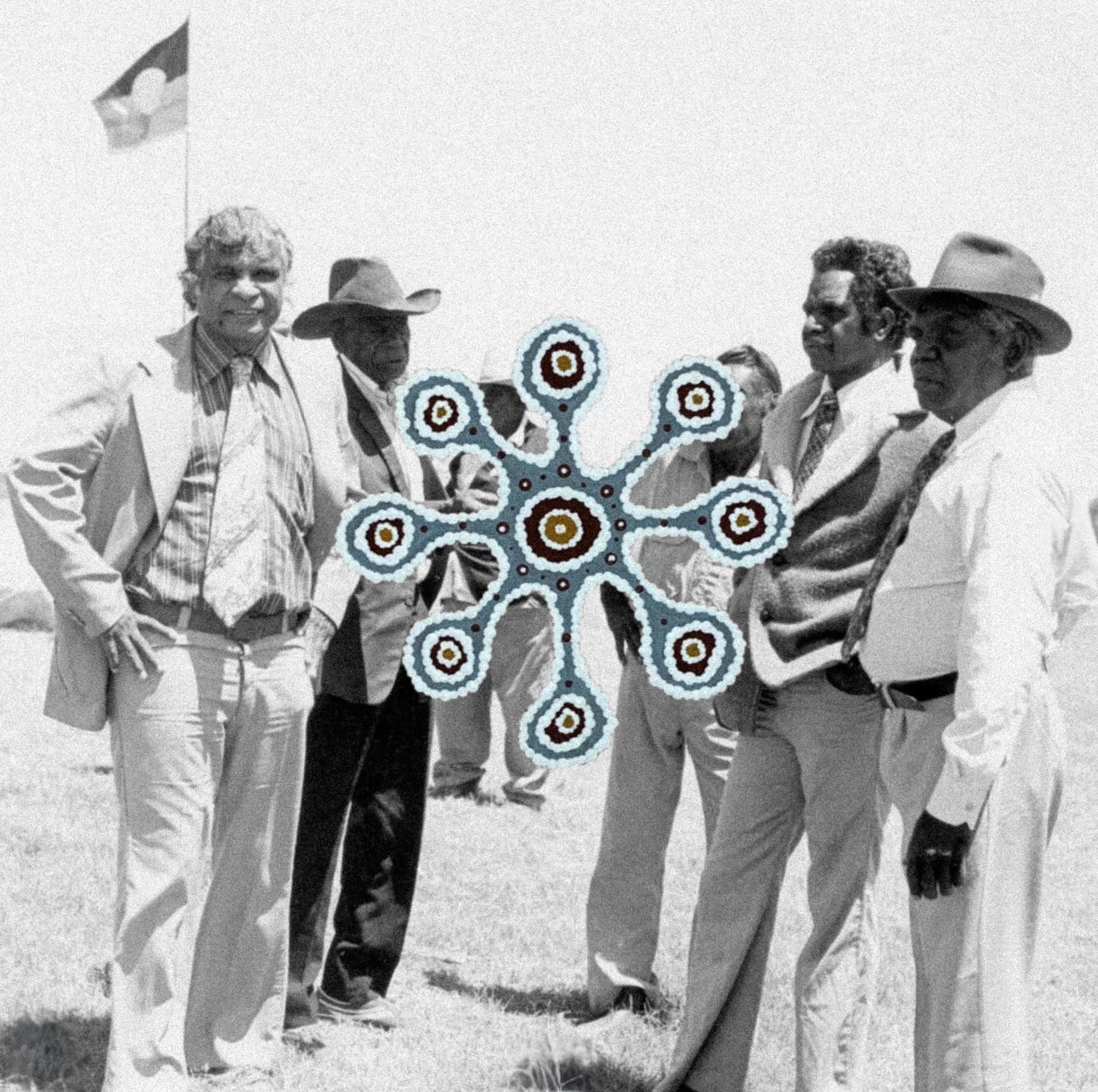
And then Kayps gives us the title track “BUNUBA BABY”.
Suddenly he’s full of bravado, calling himself the hottest brother in Boorloo City, putting on for the West and talking about Bunuba blood with complete confidence. In another context it might simply sound like the familiar self-belief of a young rapper who knows he’s good. Here, coming directly after the voice of an older generation, it feels closer to reclamation.
There is history behind that confidence, and maybe that’s why pride feels so important on this album. Kayps isn’t proud because he doesn’t know what happened. He’s proud while knowing exactly what happened, what survived and what his community continues to carry.
The same applies to the album’s politics. Kayps never treats them like a separate category of songwriting that requires the music to suddenly become serious around them.
“STICK TO THE CODE” is probably the clearest example.
It has the best and catchiest beat on the record, and everyone involved understands exactly what to do with it. Kayps, Yung Maynie, Sachém, Denzel Kennedy and Big Deej move through the track with so much confidence that it is easy to imagine the song becoming a live favourite.
Yet underneath that energy are many of the same concerns running through the rest of the album: tokenism, culture, land, money, family and the responsibility of standing with your people.
The message doesn’t interrupt the song because, for Kayps, there doesn’t seem to be any reason those things should exist separately. A song can carry history and still make a crowd move.
Even the short “RUN BOY RUN” gives us another piece of the world Kayps has been building. He writes about a 2,524-kilometre drive, flooded roads, water seeping through the door, six-foot ant hills in the distance, salt mounds, camping and the river continuing to rise. So much of the album is about what home means politically, culturally and personally, but here Kayps almost just lets us travel through it with him.
“SONNY WALTERS” brings the anger straight back. Kayps is looking at the systems surrounding his community again, calling out the way Indigenous culture can be celebrated when it is convenient while the politics rarely reflect that same admiration.
He moves through homelessness, incarceration and the history people would rather ignore, and by this point in the album you realise how easily Kayps moves between the past and the present because, in his writing, the two are constantly affecting each other.
That balance is one of the album’s biggest strengths, particularly because the further Kayps takes us into his world, the less straightforward his own place within it becomes.
“GOODY” is where that tension finally comes to the surface.
“Am I an imposter in my own culture?”
After hearing Kayps spend much of the album defending his identity so forcefully, the question catches you off guard.
He begins thinking about the distance that has grown between himself and his father’s teachings, wondering whether he understands himself well enough to be the kind of role model he wants to become. He talks about friends seeing him cry more often, accepting that he needs to let his feelings out and recognising that healing might require a kind of vulnerability we haven’t heard much from him elsewhere.
Then he looks back at his teenage years.
“Teen years as a black kid in a white place
Any photo taken had me changing into white face.”
What follows is perhaps the hardest question Kayps asks anywhere on the record: whether he had placed himself in environments where conforming became normal enough that he began washing out his own race.
These are some of the deepest and darkest lines on the album. Anyone who has ever felt themselves changing just to belong somewhere will know how shit it feels to eventually look back and wonder how much of yourself you left behind in the process. For Kayps, that question runs even deeper because he’s talking about his culture, his father’s teachings and his identity as a Black man.
And he doesn’t really answer it. Maybe he can’t yet.
For an album filled with confrontations, “GOODY” contains the most difficult one because Kayps is no longer confronting anyone else. He is looking at himself.
The second verse makes that reflection even more significant by taking us back to where his relationship with music started. Kayps talks about making his first tape at 13, when music was one of the only places he had to put the anger he was carrying. He remembers Ducky supporting him, Goonie seeing potential he hadn’t yet recognised in himself and his mum accompanying him to venues because he was still a kid.
Seven years isn’t a particularly long time, but there is an enormous distance between the artist described in that verse and the one capable of writing it.
The anger hasn’t disappeared, BUNUBA BABY wouldn’t be the same record if it had. What has changed is Kayps’ ability to understand what sits around it.
He can now trace personal experiences back through family and history, recognise that pride and uncertainty aren’t opposites and write about his community without reducing it to what has happened to it. Just as importantly, he can write about himself without pretending his own story exists outside the people who raised him.
That becomes especially clear on the closing track, “BROKEN GLASS”.
Kayps and BADASSMUTHA write openly about generational trauma and systems that continue to make decisions affecting their communities, but towards the end of the track, Kayps’ attention shifts.
“Money comes and goes, but your community’s forever
If you’re hurting, then at least we hurt together.”
After everything that precedes it, the sentiment doesn’t feel sentimental. If anything, it reveals what has been underneath the album from the beginning.
For all the justified anger running through the album, anger isn’t really what holds the record together, Community does.
Kayps keeps returning to cousins, family, his father, his grandfather, his Elders, the people who backed him when he was 13, the people he has lost and the younger generation now looking towards him. Even his most personal questions are connected to what those relationships mean.
It is why the album’s framing through Wangki Radio works so well.
At the beginning, Natalie Davey announces BUNUBA BABY across the Fitzroy Valley. What follows feels like Kayps filling that broadcast with everything he wants carried through it: memories of home, uncomfortable history, anger, humour, grief, pride, uncertainty and the voices of people around him.
Then Natalie returns at the end.
“If you’re still with me, that was Bunuba Baby.”
She reminds everyone that it’s hot outside and tells them to stay cool.
After everything we’ve heard, there is something almost perfect about how ordinary that ending is.
Because at the forefront of all of this is Kayps. It’s his story, his perspective of the world and the community around him, but that doesn’t take away from what the album really becomes by the time it’s over.
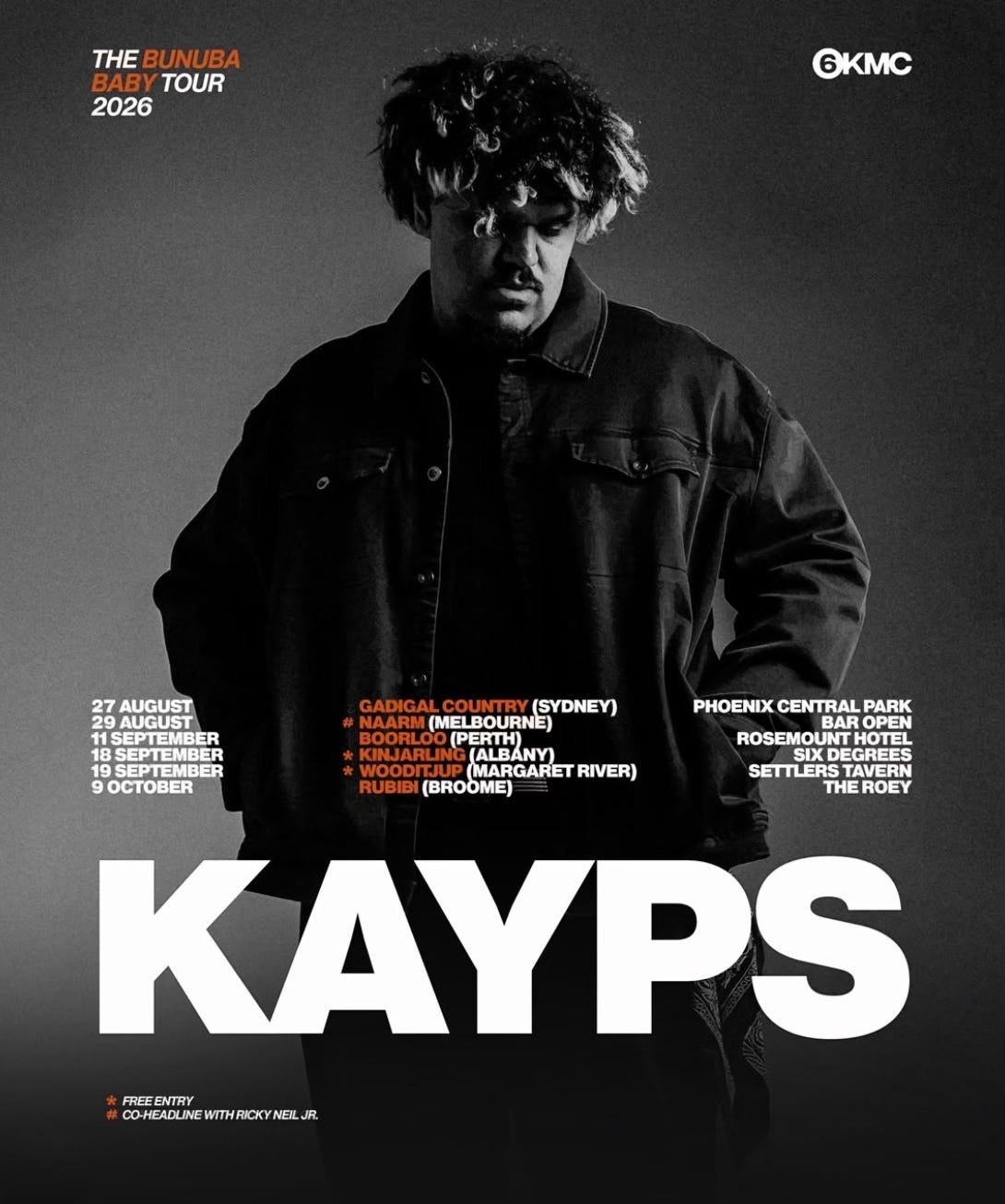
This is an album about community.
It’s about history and the things people went through, but also what those experiences did to the people around them and the generations that came afterwards. It’s about what gets passed down, what gets taken away, what survives and what people do with all of that when it eventually becomes theirs to carry.
Which is why it feels fitting that BUNUBA BABY itself doesn’t exist because of Kayps alone.
There are featured artists all over this record bringing their own stories and perspectives into his world. There are producers shaping how those stories sound, the people behind the mixing and mastering, the artwork, Natalie Davey and Uncle Johnny’s voices, and everyone else who helped turn the idea into the album we’re hearing now. You can feel that people understood what Kayps was trying to make here and brought their A-game because of it.
Take those people away and BUNUBA BABY wouldn’t be the same album.
In that sense, maybe the way this record was made tells us as much about it as the lyrics do. Kayps spends 11 tracks reminding us that nobody’s story really exists by itself, and the album carrying those stories was built by a group of people around him.
But standing at the front of that community is still this 20-year-old artist who started making music at 13 because he needed somewhere to put everything he was feeling. Seven years later, he’s not just putting those feelings onto a page anymore. He’s understanding where they came from, connecting them to the people who came before him and finding a way to make other people listen.
And it really does feel like Kayps is ready to claim his place. Not only within Australian hip-hop, either.
There is something much bigger in what he’s building here. The ability has always been obvious, but this album gives that ability purpose. Kayps knows where he comes from, he’s starting to understand exactly what he wants to say, and now he’s becoming good enough as a songwriter to make people far outside his own world stop and listen.
If there was only one Australian hip-hop artist we could put our weight behind right now, Kayps would be it.
BUNUBA BABY shows exactly why.
At 20 years old, he’s made the best record of his career so far, but I don’t think this conversation needs to stop at Kayps either. For us, BUNUBA BABY is already in the conversation for one of the best Australian albums of 2026.