

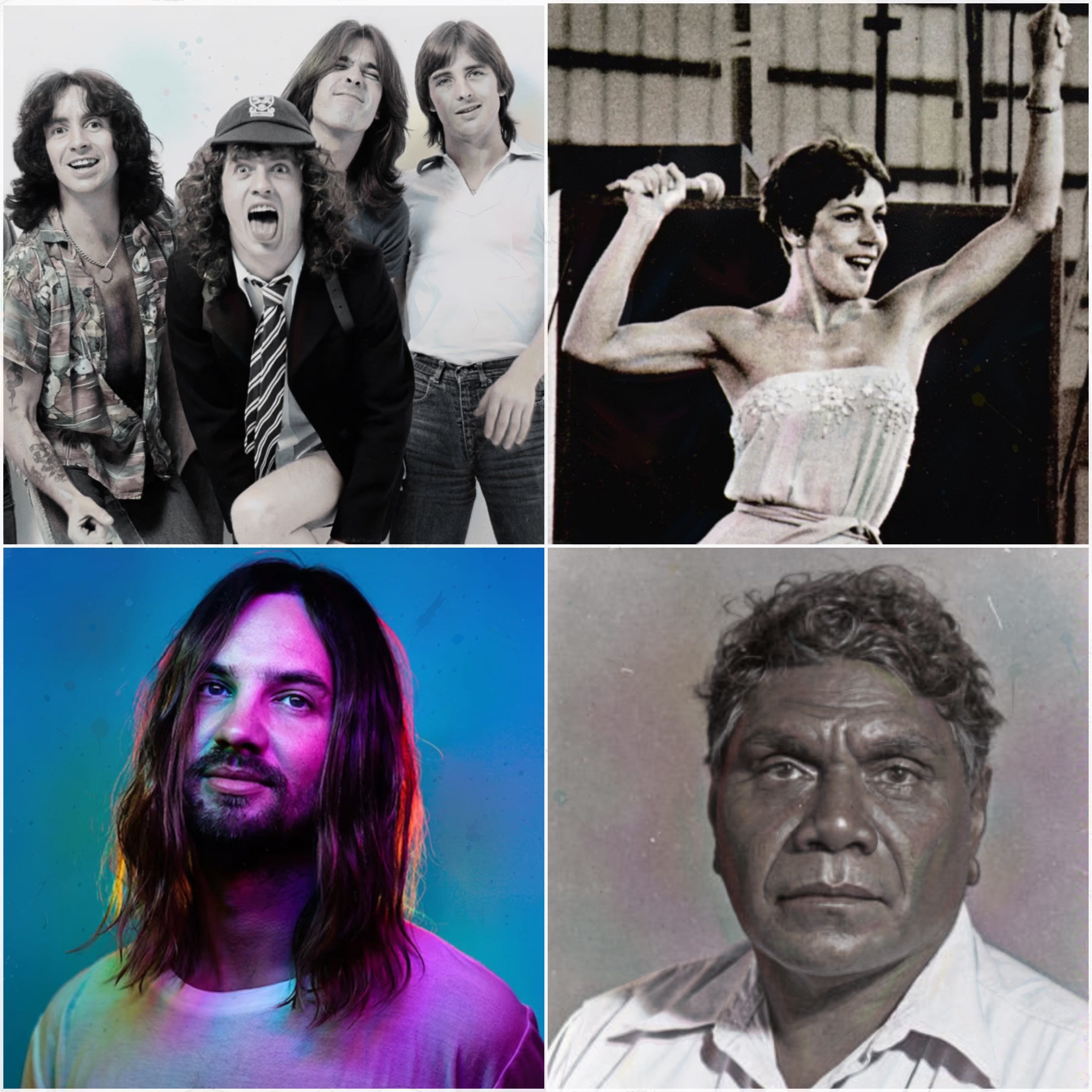
Australia’s music story is often reduced to a shortlist of exports: AC/DC, Kylie Minogue, INXS, Tame Impala, Sia. Big names, real achievements, global reach, but they only tell part of the story.
The fuller picture is messier, richer and far more revealing. It begins long before federation, before charts and record labels, in the living musical traditions of Aboriginal and Torres Strait Islander peoples. It moves through bush ballads, dance halls, migrant influence, sweaty pub stages, pirate radio energy, suburban garages, community scenes and internet-born artists creating far from the traditional centres of culture.
Australia did not inherit one sound, it built one from influences from all over.
Because of geography, Australian artists have long worked with a strange tension: close enough to absorb global influence, far enough to reshape it. Styles often arrived from Britain, America or elsewhere, but rarely stayed unchanged.
Rock got rougher, pop leaned brighter (or just weirder), punk felt more unhinged, electronic music opened up and became more expansive, and hip-hop turned into a way of talking about migration, class and what modern Australia actually looks like.
Again and again, Australian music has turned distance into character.
Before the Nation: The First Music of the Land
Any serious history of Australian music must begin with the one of the oldest continuing cultures on Earth.
For tens of thousands of years, Aboriginal and Torres Strait Islander peoples have sustained musical traditions tied to ceremony, language, kinship, memory and Country. Music was a way of carrying knowledge, law, ancestry and relationship through generations.
Songlines connected land, navigation and story, while voice, rhythm and dance carried deep communal meaning. Instruments varied across regions — from clapsticks and drums in some Torres Strait Islander traditions to the yidaki, often called the didgeridoo in English, especially associated with Arnhem Land.
This isn’t a prelude to Australian music history, it’s the foundation of it.
Modern Australian music continues to be shaped by First Nations artists bringing language, truth-telling, humour, resistance and continuity into contemporary forms.
Bush Ballads, Folk Songs and a Colonial Identity
After British colonisation began in 1788, imported Irish, Scottish and English folk traditions met convict hardship, frontier violence, labour culture and the realities of distance.
Songs travelled through camps, settlements, shearing sheds and goldfields. Over time, bush ballads emerged as one of the first recognisably local popular forms: songs about workers, wanderers, injustice, drought, survival and irreverence toward authority.
No song became more symbolic than “Waltzing Matilda,” first published in the 1890s. It was not an official anthem, but it functioned like one for many people: proof that music could help imagine a national identity before the nation fully existed.
Australian music was already doing something it would keep doing for generations: mythologising itself while laughing at itself.
Cities, Dance Halls and the Radio Age
By the early twentieth century, Australia’s urban centres were increasingly plugged into international entertainment culture. Jazz, vaudeville, theatre orchestras and dance halls flourished in Sydney, Melbourne and beyond.
Broadcast music created shared listening across enormous distances. What happened in one city could now be heard nationally. It helped turn performers into household names and helped audiences develop a common cultural reference point.
American jazz and swing had major influence, but local scenes mattered too. Australia was no longer only consuming music, it was building an industry around it.
Rock ’n’ Roll and the Birth of Youth Culture
The arrival of rock ’n’ roll in the 1950s changed Australian culture in the same way it did elsewhere: teenagers suddenly had music that felt like theirs.
Johnny O’Keefe became one of the country’s first major rock stars, helping localise a genre born overseas. Television, introduced in 1956, accelerated the shift. Music was now visual as well as sonic.
By the 1960s, surf groups, beat bands and pop acts were thriving. Australia still looked heavily to Britain and America, but something important had changed: the infrastructure for a homegrown modern music culture now existed.
The Pub Rock Era: Australia Finds Its Volume
If one movement most clearly shaped modern Australian music identity, it was pub rock.
From the 1970s into the 1980s, an extensive circuit of hotels, pubs and clubs became one of the toughest live proving grounds in the world. Bands had to win audiences in real time.
You either had songs, stamina and presence, or you didn’t.
This environment helped produce acts such as:
AC/DC
Cold Chisel
Midnight Oil
The Angels
Rose Tattoo
Australian Crawl
early INXS
Pub rock was physical music built for crowded rooms. Working and middle-class spaces turned live music into ritual: a release after work, a social language, a place where national temperament could be heard at full volume.
Australia did not just imitate rock music, it toughened it.
Punk, Post-Punk and the Outsiders
Not every artist belonged in the pub rock mould.
Brisbane’s The Saints were among the earliest great punk bands anywhere, releasing “(I’m) Stranded” in 1976. Their urgency arrived almost simultaneously with first-wave punk in the UK and US, a reminder that Australia was not always culturally behind.
Then came stranger forms.
Nick Cave and The Birthday Party turned chaos into theatre. Underground scenes in Melbourne and Sydney embraced noise, goth, experimental rock and outsider identity. These artists often benefited from distance. Removed from global trend centres, they could become harsher, weirder and less obedient.
That outsider streak would become one of Australia’s most valuable musical traits till date.
Country Music and Regional Australia
While urban scenes often dominate cultural narratives, country music has been one of Australia’s most enduring and commercially significant traditions.
Artists such as Slim Dusty helped define a distinctly Australian country voice rooted in roads, labour, humour and regional life. Later figures like John Williamson and Kasey Chambers carried the form into new eras.
This mattered because Australia has never only been a city story. Regional identity, rural mythology and life beyond metropolitan centres have always shaped national culture. Country music kept that perspective audible.
Pop Exports and International Success
By the late 1980s and 1990s, Australian artists were no longer just domestic stars or touring bands. They were global figures.
INXS became one of the era’s biggest bands. Kylie Minogue became an international pop institution. Savage Garden topped charts worldwide. Natalie Imbruglia’s “Torn” became one of the defining pop songs of its moment. The Bee Gees, though born in the UK, developed significantly in Australia before global fame.
Australia had entered the export era.
The significance was psychological as much as commercial. Australian artists no longer needed to leave identity behind to compete internationally.
Triple J and a National Taste Culture
Few institutions shaped contemporary Australian music more than triple j.
Originally launched in Sydney in 1975 before later expanding nationally, the youth broadcaster became a discovery engine, gatekeeper, community hub and launchpad for local talent. For many Australians, triple j was not just radio, it was a map.
Its annual Hottest 100 became a national ritual. Its support helped build careers across genres.
Through the 1990s and 2000s, artists such as:
Silverchair
Powderfinger
Grinspoon
Missy Higgins
The Living End
Hilltop Hoods
Jet
Wolfmother
all benefited from a culture where local music still had shared national pathways.
Streaming later fragmented this monoculture, but for decades triple j gave Australia something rare: a common soundtrack.
Women Who Reshaped the Story
No honest history of Australian music can treat women as side notes.
From Helen Reddy’s global impact in the 1970s to Kylie’s pop longevity, Tina Arena’s vocal legacy, Missy Higgins’ songwriting voice, Courtney Barnett’s indie sharpness, Sia’s global songwriting dominance, Amy Shark’s commercial rise, and countless others, women have repeatedly expanded what Australian music could be.
They have often done so while navigating industries slower to recognise them.
Today, many of the country’s most exciting scenes right now are being shaped by women and non-binary artists across indie, electronic, punk, R&B and pop.
Tame Impala and the New Global Cool
Kevin Parker’s Tame Impala marked another shift.
Emerging from Perth, far from eastern media centres, the project fused psychedelic rock with obsessive studio craft and pop instinct. What began as a celebrated psych act became one of the most influential modern bands anywhere.
The symbolism mattered more than people realise, it showed how an artist working from geographic distance can now shape global sound directly.
And, honestly that had always been Australia’s hidden advantage.
Hip-Hop, Migration and the New Australia
Australian hip-hop began as a niche movement but has become one of the clearest mirrors of contemporary national identity.
Early commercial breakthroughs included Hilltop Hoods and Bliss n Eso. Later generations widened the frame dramatically.
Artists from migrant communities, suburban scenes and First Nations backgrounds used rap to speak about race, policing, class, belonging, masculinity and ambition.
Acts such as A.B. Original, Briggs, Barkaa, OneFour, Genesis Owusu and many others helped move Australian hip-hop beyond imitation into something culturally specific and urgent.
First Nations Renaissance
Contemporary Australian music is increasingly unimaginable without First Nations leadership.
Archie Roach’s truth-telling, Gurrumul’s spiritual presence, Yothu Yindi’s historic crossover success, Baker Boy’s language-forward joy, Thelma Plum’s songwriting, King Stingray’s Yolŋu surf-rock energy and many more have reshaped the national soundscape.
Some of the most future-facing Australian music is also deeply connected to the oldest traditions.
That is what is really exciting about whats happening in the current scene.
What Australian Music Sounds Like Now
Today, Australian music is less unified and more alive than ever.
Streaming ended the old monoculture. Scenes now coexist rather than dominate.
Melbourne continues to thrive as a live music city with punk, indie, jazz and underground energy.
Sydney produces rap, pop and hybrid scenes shaped by migration and density.
Perth maintains a reputation for left-field innovation.
Brisbane and Adelaide sustain strong independent communities.
Regional artists can now build audiences online without relocating first.
Genre boundaries matter less than they once did. A rapper may make punk songs, a country artist may use electronic production, or a rock band may think like bedroom producers.
The old question was: What does Australian music sound like?
The better question now is: How many Australian sounds can exist at once?
Moments That Defined the Sound
Throughout its history, Australian music hasn’t just evolved through genres — it has been shaped by moments. Breakthrough performances, political songs, global successes and underground movements that shifted perception. These moments remind us that the story of Australian music isn’t just gradual — it’s punctuated by impact.
AC/DC Breaks Through Globally (Late 1970s)
From Sydney pubs to global arenas, proving Australian rock could travel.
The Saints Release (I’m) Stranded (1976)
A foundational punk moment.
Yothu Yindi – Treaty (1991)
A defining political song in Australian music.
The Triple J Hottest 100 Era (1990s–2000s)
A cultural institution shaping national taste.
Flume Wins a Grammy (2017)
Australian electronic music reaching global dominance.
Australia never had one musical identity. It had many, often arguing with each other.
Its greatest artists have emerged from contradiction: isolation and ambition, roughness and craft, humour and melancholy, local scenes and global dreams.
That may be why Australian music continues to resonate.
It was never built from certainty. It was built by people far from the centre, trying to make something real — and discovering that the distance itself could become a strength.