

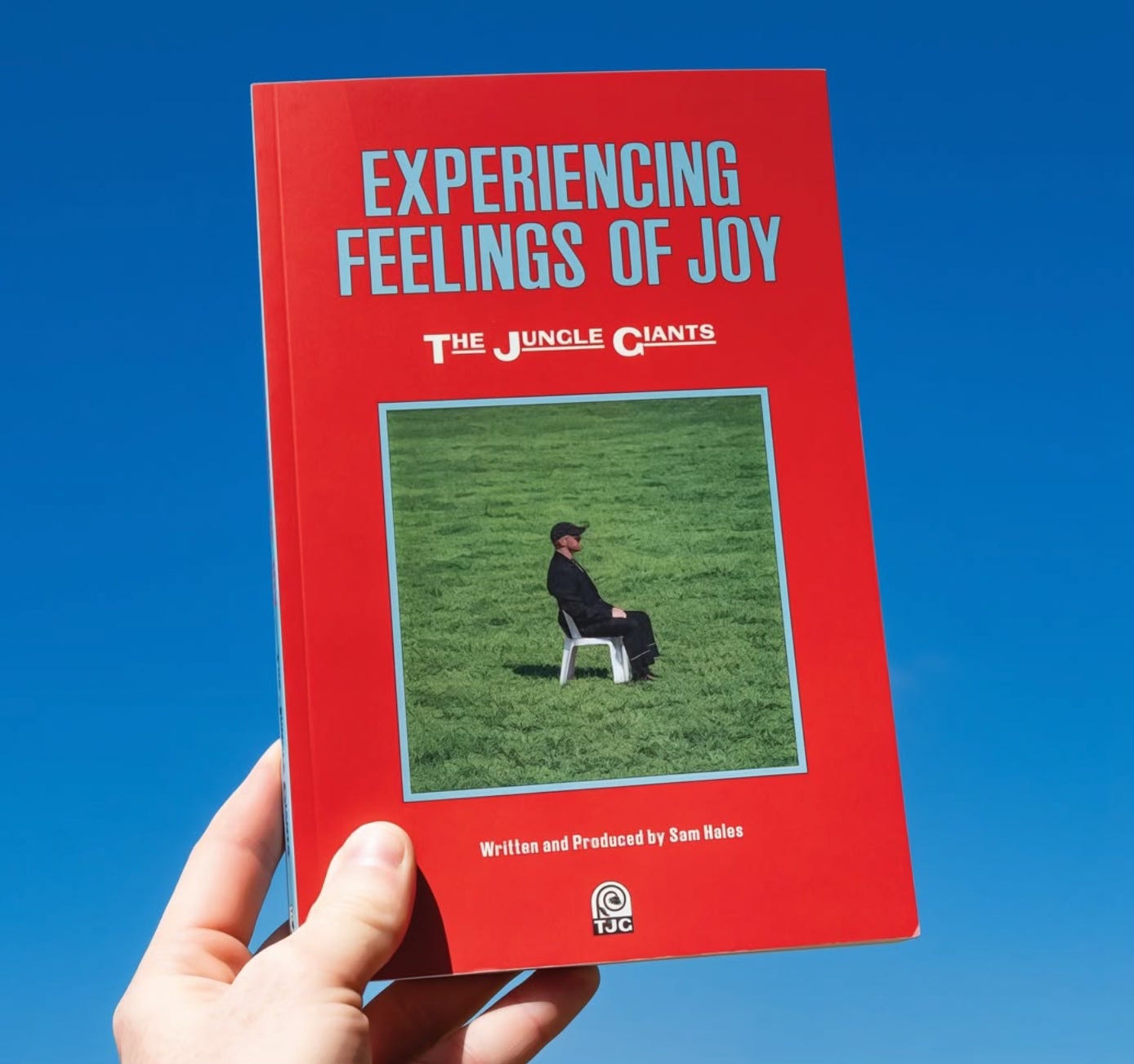
Joy is often the last thing people believe they deserve when going through the darkest phase of their life. But that search for joy is exactly what led Sam Hales from The Jungle Giants to create their fifth album Experiencing Feelings of Joy.
Behind the colourful production and euphoric indie-pop moments sits an album born out of emotional collapse, heartbreak, and creative paralysis. Hales had not only lost someone deeply important in his life, but also the person he had been creating music alongside for years.
For an artist, losing both emotional connection and creative direction at the same time can feel like losing your entire identity. Understandably, that period pushed him into one of the darkest mental spaces of his life.
What eventually gave him a glimpse of light was stumbling onto The Artist’s Way by Julia Cameron — a book centred around reconnecting with creativity and rebuilding your relationship with yourself through art.
In many ways, Experiencing Feelings of Joy feels like Hales creating his own version of that process in musical form. The album almost plays like a self-help book disguised as an indie-pop record, documenting someone slowly learning how to feel alive again through creating.
What makes this even more interesting is that you would never immediately guess the emotional state Hales was in when first listening to the album. Sonically, the record opens with warmth, movement, and an almost celebratory energy. Instead of drowning in sadness, Hales chooses to fight through it with colour, rhythm, dancing, and human connection.
That emotional contradiction is captured perfectly on the opening track, which is dedicated to Hales’ mother and already feels destined to become one of the band’s defining songs. Beneath its infectious energy sits a deeply personal tribute to unconditional love, resilience, and the people who keep us grounded when life begins to collapse around us.
When Hales sings:
“Mumma did you know your love is kinda punk
Ain’t no man was stoppin’ you from raisin’ me all on your own”
it becomes clear that this album is not simply about escaping darkness, but about finding the people, memories, and emotions that help you survive it. Even the repeated refrain — “Will you tell me how it feels baby?” — feels less like a hook written for a crowd, and more like someone desperately trying to reconnect with emotion itself.
For perhaps the first time in a Jungle Giants record, Sam Hales feels completely exposed as a songwriter. And that vulnerability is exactly what makes Experiencing Feelings of Joy their most human album yet.
The Search for Joy
What makes Experiencing Feelings of Joy so emotionally interesting is that the album never sounds like it was written from a place of complete healing. Instead, it feels like Sam Hales documenting the process of trying to get there in real time.
Across the album, joy is not presented as a permanent emotional state or some perfect ending waiting at the finish line. It feels more like a conscious decision to keep moving, keep loving, keep dancing, and keep creating even when parts of your life are collapsing underneath you. That tension between emotional pain and sonic euphoria becomes the defining heartbeat of the record.
And sonically, the album fully commits to that idea.
The first four tracks are incredibly upbeat, colourful, and alive. The production constantly pushes towards movement, warmth, rhythm, and connection. Even when the lyrics are dealing with heartbreak, loneliness, uncertainty, or emotional confusion, the compositions themselves almost refuse to stay emotionally stagnant. The music wants to move forward. It wants to breathe, and dance its way through the darkness rather than sit still inside it.
That contrast becomes one of the album’s strongest qualities. Songs about longing, breakups, emotional distance, and vulnerability are wrapped inside some of the brightest and most accessible compositions The Jungle Giants have ever created.
The upbeat nature of the album doesn’t exist to hide the pain. It probably exists because of the pain.
There’s a feeling throughout the project that Sam Hales is using music itself as a way to reconnect with life again. Whether it’s love, friendship, physical touch, community, romance, dancing, or simply being present in a moment, the album constantly searches for emotional experiences that make existence feel meaningful again.
Around the middle of the record, the emotional cracks begin to show more openly. Tracks become slightly more introspective, more reflective, and more emotionally exposed, but the album never fully loses its warmth.
That’s what makes the sequencing of the album so effective. The joy never feels naive, and the sadness never completely consumes the record. Instead, both emotions constantly coexist beside each other.
By the time the album reaches World’s Getting Smaller, the emotional walls fully come down.
The production becomes more stripped back, more spacious, and far more vulnerable than anything that came before it. After an album filled with movement and colour, the closing track almost feels like the moment after the party ends and someone is finally left alone with their thoughts.
It’s easily the most emotionally exposed moment on the record, and perhaps the clearest glimpse into the emotional state Hales was navigating while creating this project.
What makes the ending particularly powerful is that the album never fully resolves its emotions. It doesn’t pretend heartbreak disappears. It doesn’t offer some grand conclusion about healing.
Instead, Experiencing Feelings of Joy understands something far more human: sometimes healing simply means finding enough reasons to keep feeling things again. And that’s exactly what this album does.
Sound Under Top 3 Picks
1) Tell Me How It Feels
There could not have been a more perfect opener for Experiencing Feelings of Joy. In many ways, Tell Me How It Feelsacts as the emotional thesis of the entire album. It captures everything the record is trying to say — love, community, movement, vulnerability, emotional survival, and the search for connection during moments where life feels emotionally overwhelming.
At the same time, it also feels destined to become one of the biggest songs in The Jungle Giants catalogue.
What makes the track so powerful is the contrast at the centre of it. Sonically, the composition is bright, euphoric, danceable, and full of life. But underneath that energy sits someone desperately trying to reconnect with emotion, purpose, and the people around them. That emotional bait-and-switch becomes one of the defining characteristics of the entire album, and this track introduces it perfectly.
The production constantly moves forward with warmth and momentum, while Sam Hales delivers some of the most emotionally open writing of his career.
The emotional core of the song ultimately comes back to love — not just romantic love, but the love of family, home, friendship, memory, and the people that shape who we become. Lines directed towards his mother become some of the most powerful moments on the entire album, grounding the song in something deeply personal rather than purely euphoric.
2) All The Time In The World
At just over five minutes long, All The Time In The World is the longest track on the album — something that almost feels rebellious in an era where attention spans are shrinking and songs are increasingly designed for short-form consumption. But rather than overstaying its welcome, the track slowly pulls you deeper into its emotional warmth with every passing minute.
This is easily some of the finest songwriting on the entire project.
What immediately stands out is just how effortlessly addictive the song is. The hook is arguably the strongest on the album, and one of the reasons the record works so well as a listening experience overall is because of how naturally these songs embed themselves into your head.
There’s a warmth and repetition to many of the melodies that almost feels comforting rather than commercial. The album understands the power of earworms, but it uses them emotionally instead of mechanically.
Sonically, the track fully embraces the euphoric and romantic side of Experiencing Feelings of Joy. The composition feels weightless, patient, and deeply sincere.
That’s what makes the writing feel so effective.
The emotional core of the track is beautifully captured in the chorus:
“We got all the time in the world
And you know you’re my favourite girl
They say love comes, let it unfurl”
There’s something incredibly human about the simplicity of those lines. No overcomplicated metaphors, or emotional games. Just someone trying to hold onto a feeling before life changes again.
3) World’s Getting Smaller
If Tell Me How It Feels represents the emotional heartbeat of the album, then World’s Getting Smaller feels like the emotional aftermath.
This is Sam Hales at his most vulnerable and emotionally exposed. After an album filled with movement, colour, groove, and euphoric compositions, the closing track strips almost everything back. The production becomes quieter, more spacious, and far more intimate, allowing the emotional weight of the writing to sit completely in the foreground.
And that restraint is exactly what makes the song so powerful.
There’s a feeling throughout the track of someone looking back at one of the hardest periods of their life with a clearer perspective. Not necessarily healed, but emotionally aware enough to finally sit with the pain instead of trying to outrun it. Unlike many of the earlier songs on the album that use rhythm and energy as emotional survival mechanisms, World’s Getting Smaller feels like the moment where all distractions disappear and only honesty remains.
And throughout the track, Hales captures a feeling that many people experience after heartbreak — the strange contradiction of living in a world that feels increasingly connected while emotionally feeling further away from someone than ever before.
“If the world that we’re living in is getting smaller
Why do you feel so far away?”
That hook alone carries the emotional weight of the entire song.
What makes the ending of the album especially beautiful is that despite all the heartbreak and emotional distance being described, there’s still love present inside the writing. Even in loss, Hales never fully turns cynical. If anything, the pain exists because the love itself was real.
And perhaps that’s the final message of Experiencing Feelings of Joy.
By ending the album in such a stripped-back and emotionally vulnerable way, The Jungle Giants leave listeners with the clearest glimpse into who Sam Hales really was while making this record — someone trying to rediscover joy while still carrying the weight of everything he had lost.
Very few albums manage to sound this joyful while carrying this much emotional weight underneath them. That’s what makes Experiencing Feelings of Joy such a special record.
At its core, this is not an album about someone who has fully healed or figured life out. It’s an album about someone learning how to survive again through music, movement, love, vulnerability, and creation itself. Sam Hales takes heartbreak, creative paralysis, loneliness, and emotional exhaustion, and somehow transforms those feelings into some of the warmest and most life-affirming songs The Jungle Giants have ever made.
What makes the album resonate so deeply is that it never pretends pain magically disappears. Even in its most euphoric moments, there’s still sadness living underneath the surface. But rather than allowing that darkness to consume the record, Hales chooses to dance through it, sing through it, and create through it. And in many ways, that feels like the entire message of the album itself.
By the time World’s Getting Smaller closes the record, it becomes clear that Experiencing Feelings of Joy is less about reaching happiness, and more about rediscovering the ability to feel things again after emotionally losing yourself for a period of time.
This might end up being one of the strongest albums released in 2026, and certainly one of the most emotionally honest records in The Jungle Giants’ catalogue. At some point, we’d love to sit down with Sam Hales for a deeper conversation around this project, because this album genuinely feels like it still has layers left to unpack beneath the surface.